Vodka & Neutral Spirits Library / Vodka Category Guide
Vodka
Fundamentals
Material, Rectification & Sensory Control.
Vodka starts with agricultural material and fermentation, then moves toward controlled reduction of character. This guide follows that sequence through rectification, filtration, water, law, labels and the glass.
Scope Neutral spirit is the technical foundation. Vodka is the finished regulated category. Legal thresholds are always attached to the market that sets them.
Start with the category →Continue where you left off →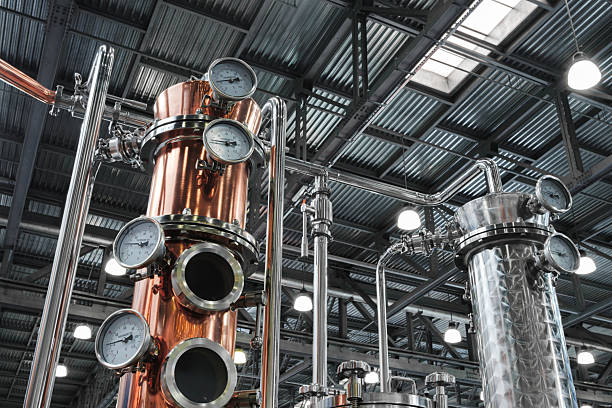
Separate neutral spirit production from the finished vodka category
Trace how material, fermentation, rectification, filtration and water shape the bottle
Read vodka law, labels and sensory claims with a repeatable order
Guide contents
Nine short chapters. Follow the production sequence or jump straight to the question you need on shift.
Vodka and neutral spirit answer different questions
Start with the technical base, then move to the regulated finished category.
Neutral spirit: the production foundation
Neutral spirit describes alcohol distilled to very high strength with a low level of congeners. Repeated vapour–liquid contact concentrates ethanol while reducing and separating volatile compounds.
The result can become the base for vodka, gin, liqueurs and other compounded spirits. “Neutral” describes a production target rather than chemically pure ethanol.
Vodka begins after fermentation has already created character. Rectification and later processing determine how much of that character remains, and the finished product must meet the rules of the market where it is sold.
Vodka: the finished category
In the European Union, vodka is produced from ethyl alcohol of agricultural origin and the characteristics of the raw material and fermentation by-products are selectively reduced. Additional distillation or processing may follow.
In the United States, vodka is a type of neutral spirit under 27 CFR § 5.142. The two systems describe the route differently, so thresholds and permissions must always be taught with their jurisdiction.
Base alcohol → finishing process → legal market → bottling strength → sensory result.
The raw material supplies fermentable sugar
Material changes preparation and fermentation before the spirit reaches the rectification system.
Different materials, different preparation
Cereals and potatoes are historically important. Other agricultural raw materials can also be used where the relevant law permits them.
Milling, cooking and enzymatic conversion make starch available as fermentable sugar.
Starch is gelatinised and converted before yeast can ferment the resulting sugars.
Read the jurisdiction and the label. In the EU, material beyond cereals and potatoes triggers a prominent raw-material statement.
Raw material affects yield, nutrient availability, fermentation behaviour and the mixture of congeners entering distillation. Its influence continues through the process rather than standing alone as the finished flavour explanation.
Fermentation creates alcohol and congeners
Character exists before the producer starts reducing it.
Follow the sequence
Yeast converts fermentable sugars into ethanol, carbon dioxide and aroma-active compounds. Yeast strain, temperature, nutrient balance, fermentation time and the condition of the raw material influence the fermented wash.
Mill, cook or otherwise prepare the agricultural base.
For starchy materials, enzymes convert starch into sugars yeast can use.
Yeast produces ethanol plus fermentation-derived compounds.
Alcohol and volatile compounds move into the distillation system.
Repeated separation and optional filtration shape the profile.
Water and permitted final adjustments set the release strength and composition.
Clean, controlled fermentation gives the rectification system a consistent feed. Rectification can remove many congeners, while fermentation still matters to efficiency and the character available to retain.
Rectification is the engine of neutrality
Repeated separation stages concentrate ethanol and manage volatile compounds.
More contact, sharper separation
Trays or packing create repeated contact between rising vapour and descending liquid. Reflux returns part of the condensed liquid to the column, increasing that contact and sharpening separation.
The distiller controls heat, flow, reflux and draw points to meet the required specification. Alcoholic strength is one measurement; residue limits and sensory quality also matter.
Minimum strength for EU ethyl alcohol of agricultural origin.
US threshold at or above which distilled spirits qualify as neutral spirits.
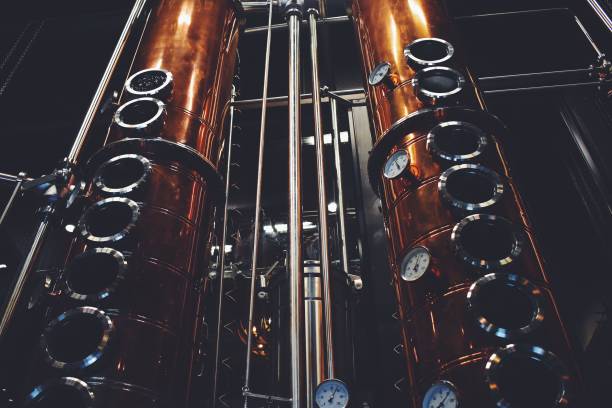
Trays or packing provide repeated separation stages.
Returned condensate increases vapour–liquid contact and separation efficiency.
Different parts of the system allow streams to be removed, recycled or collected.
“Distilled five times” is a process count. Column design, effective separation stages, operating conditions and final composition tell you more about what the claim means.
Filtration is targeted refinement
Filtration works on an already produced spirit and should be read by purpose, method and result.
Ask what the filtration was designed to change
Activated carbon can reduce selected compounds after distillation. Contact time, temperature, flow rate, carbon type and spirit strength influence the result.
The EU framework permits appropriate processing aids, including activated charcoal, to give vodka special organoleptic characteristics. In the US, the specific “charcoal filtered” statement has a defined treatment condition.
“Filtered three times” tells you the number of passes, but not how much the filtration changed the spirit. Carbon type, contact time, temperature, flow rate and spirit strength determine the effect.
Water determines the final composition
High-strength spirit becomes bottling-strength vodka through controlled dilution and final quality checks.
Dilution is a production stage
Water becomes a major component of the finished vodka. Producers may treat available water to reach a consistent mineral and sensory specification using filtration, demineralisation, reverse osmosis or other suitable systems.
Dilution changes the concentration of ethanol and congeners, and therefore the perception of aroma, heat and texture. Producers may rest the diluted spirit before final filtration and bottling, followed by laboratory and sensory checks.
Read the water claim in two parts: where the water came from, and how the producer prepared it for the final composition.
Legal neutrality changes across markets
Attach every threshold and permission to the jurisdiction that sets it.
| Question | European Union | United States |
|---|---|---|
| Base alcohol | Ethyl alcohol of agricultural origin. It must reach at least 96.0% abv and meet residue limits. | Neutral spirits are distilled from suitable material at or above 95% abv. |
| Vodka concept | Raw-material and fermentation characteristics are selectively reduced; additional distillation or appropriate processing may follow. | Vodka is a type of neutral spirit under 27 CFR § 5.142. |
| Minimum bottling strength | 37.5% abv. | Neutral spirits, when bottled, are bottled at not less than 40% abv. |
| Sweetening / adjustment | Up to 8 g/L of sweetening products, expressed as invert sugar, to round off taste. | Vodka may be treated with up to 2 g/L sugar and up to 1 g/L citric acid. |
| Colour / wood | Vodka shall not be coloured. | Vodka may not be aged or stored in wood barrels, apart from the narrow paraffin-lined bottled-in-bond exception. |
| Raw-material label | Vodka made from materials beyond cereals, potatoes or both must prominently state “produced from …”. | The federal standard allows any suitable material; label requirements follow the applicable US rules. |
Accuracy rule: 37.5% abv and 40% abv are both correct when the market is named. Teach the jurisdiction with the number.
Continue · Chapter 08Read the regulated name before the purity story →Read the regulated name before the purity story
Start with regulated facts, then interpret producer claims.
Vodka, flavoured vodka, neutral spirits or another designation.
The legal market establishes the relevant category and minimum strength.
Look for cereal, potato or another agricultural material where stated or required.
Bottling strength changes concentration, texture and cocktail performance.
Distillation and filtration counts need equipment, conditions and purpose to become useful.
Separate raw-material origin, distillation, treatment and bottling instead of collapsing them into one place claim.
“Premium,” “ultra-pure,” “smooth” and “multiple distilled” are marketing language until the measurable production decision behind them is clear.
Taste for precision, texture and residual character
Vodka tasting works at a quieter scale: cleanliness, alcohol integration, texture and small signals matter.

Taste in the same order.
Appearance
Clarity and colour first.Aroma
Cleanliness, alcohol integration and subtle material-derived notes.Palate
Weight, viscosity, heat, sweetness perception and centre-palate precision.Finish
Clean, warming, peppery, creamy, bitter, metallic or coarse.Evidence
Connect only the production choices that the sensory evidence can reasonably support.Smoothness is one observation. A complete assessment also considers aroma precision, texture, alcohol integration, balance and finish.
Behind-the-bar recap
Read the bottle
- Category and market first
- Raw material next
- Then rectification and filtration claims
- Check bottling strength
- Separate measurable process from purity language
Behind-the-bar recap
Read the glass
- Taste at a useful temperature
- Assess cleanliness and alcohol integration
- Read texture as well as aroma
- Look for residual character
- Connect sensory evidence back to process carefully
REFSources & Further Reading
Primary legal and educational references behind this Vodka & Neutral Spirits guide. Kept here so the learning path stays uninterrupted.
The takeaway
Read the definition.
Then read the process.
Vodka style is built through raw material, fermentation, rectification, filtration, water and bottling choices. Use the label and the glass to judge how those decisions appear in the finished spirit.