Whisk(e)y Library / American Category Guide 03
Bourbon &
American Whiskey
Law, Grain, Oak & Labels.
Bourbon starts with corn, American production and charred new oak. Within those legal requirements, distillers make choices that change its flavour: the grain recipe, yeast, distillation, barrel and where it matures. This guide explains those choices and what they mean when you read a label or taste a whiskey.
Scope This guide focuses on Bourbon. Rye, Corn Whisky, Tennessee Whiskey and American Single Malt provide useful comparisons; Guide 04 explores Rye and Corn Whiskey in detail.
Explain what legally makes a whiskey Bourbon
Understand mash bills, yeast, proof, age and label terms
Recognise how new oak, warehouse conditions and strength influence flavour
Guide contents
Start with the legal definition, then follow Bourbon through production, maturation, labelling and service.
The law defines Bourbon
Where it is made, how much corn it contains, its strength and its barrels all form part of the legal definition.
What are the legal requirements for Bourbon whiskey?
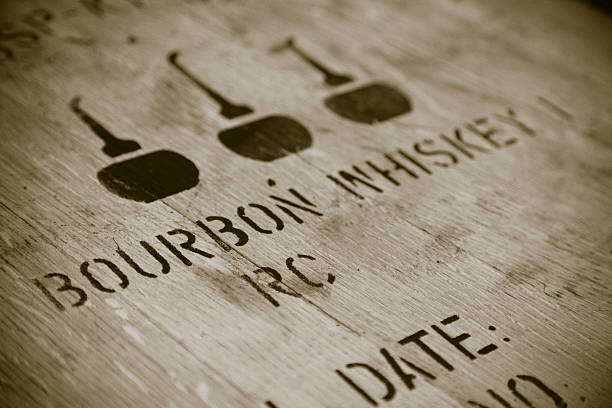
Bourbon must be produced in the United States from a fermented mash containing at least 51% corn. It must be distilled at no more than 160 proof (80% abv), stored in charred new oak barrels at no more than 125 proof (62.5% abv), and bottled at a minimum of 80 proof (40% abv). Colouring, flavouring and blending materials are not permitted.
Bourbon has no federal minimum ageing period, although storage in charred new oak is required. Straight Bourbon must spend at least two years in those barrels. Bourbon younger than four years must carry an age statement.
Water may be used to adjust strength. Added colouring, flavouring, neutral spirits and blending materials are excluded from the Bourbon standard.
The regulation specifies oak. American white oak, Quercus alba, is widely used, but the law does not require that species.
Understand the American whiskey family
Grain, barrel requirements and production strength distinguish the main American whiskey types. “Straight” adds an ageing requirement.
| Federal / state term | Main requirement | What to remember |
|---|---|---|
| Bourbon Whisky | ≥51% corn; charred new oak | U.S. produced; ≤160 proof distillation; ≤125 proof barrel entry; coloring and flavoring excluded. |
| Rye / Wheat / Malt / Rye Malt Whisky | ≥51% named grain; charred new oak | Distilled at ≤160 proof and entered into oak at ≤125 proof. Straight versions require at least two years and exclude colouring, flavouring and blending materials. |
| Corn Whisky | ≥80% corn | Oak storage is optional. If aged, it uses used or uncharred new oak at ≤125 proof; treatment with charred wood is prohibited. |
| American Single Malt Whisky | 100% malted barley; one U.S. distillery | Mashed, distilled and aged in the U.S.; oak barrels ≤700 L; used, charred new or uncharred new oak allowed. Caramel coloring is permitted when disclosed. |
| Tennessee Whiskey | State defined whiskey identity | At least 51% corn, the 160 and 125 proof limits, charred new oak, Tennessee manufacture and aging, plus maple charcoal filtration before aging under the state rule and its narrow exception. |
Straight whisky requires at least two years in the specified oak. Straight Bourbon, Rye, Wheat, Malt and Rye Malt exclude colouring, flavouring and blending materials. American Single Malt has a separate exception allowing disclosed caramel colouring, including in its straight version.
Federal regulations permit both spellings. Maker’s Mark is a familiar example: its label reads Kentucky Straight Bourbon Whisky, without the e.
For a closer look at Rye and Corn Whiskey, including how their production and flavours differ, continue to Guide 04.
Connected knowledgeCompare the legal requirements for Bourbon, Rye and Corn Whiskey →
Continue · Chapter 03The mash bill defines the grain recipe →The mash bill defines the grain recipe
The mash bill lists the grains and their proportions. Cooking and fermentation determine how the distiller uses them.
What does each grain contribute?
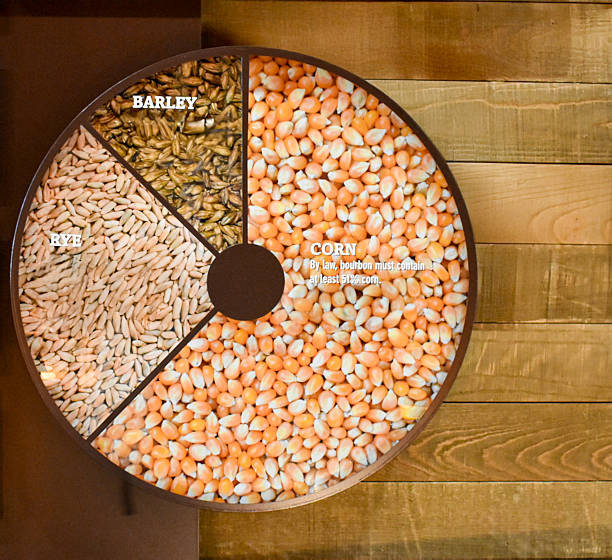
Every Bourbon mash bill contains at least 51% corn, and many contain considerably more. Rye or wheat commonly makes up part of the remainder. Malted barley often supplies enzymes that convert starch into fermentable sugars.
Cooking follows the grain. Corn usually enters first because its starch needs a higher gelatinisation temperature. Rye or wheat follows as the mash cools, then malted barley is commonly added later at a lower temperature that protects its enzymes.
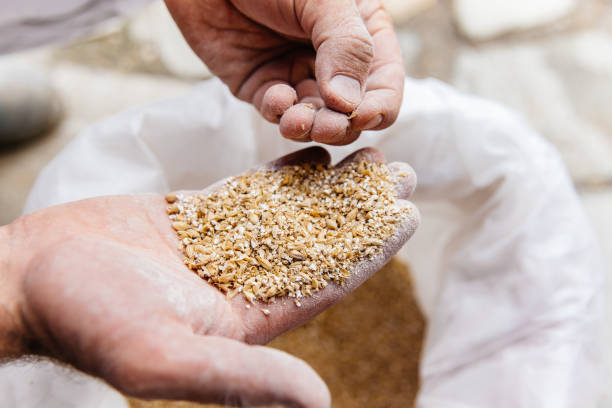
Corn must make up at least 51% of the mash. Cooking makes its starch accessible to enzymes; yeast then turns the resulting sugars into alcohol.
Rye is often associated with spice, bread and citrus notes; wheat with a softer impression and bread dough notes. These are useful tendencies, but individual Bourbons vary.
Its enzymes help convert starch into fermentable sugars. It is often added after the mash has cooled to protect those enzymes. Distillers may also use added enzymes.
The corn percentage describes the mash. The sugars that yeast ferments do not pass through distillation into the whiskey. Vanilla and caramel-like oak aromas, alcohol and texture can all contribute to an impression of sweetness.
Four Roses combines two mash bills with five proprietary yeast strains to make ten Bourbon recipes. The example shows how changing yeast can produce different results from the same grain recipe.
Sour mash controls the fermentation environment
Sour mash uses acidic liquid left after distillation to help control the conditions for the next fermentation.
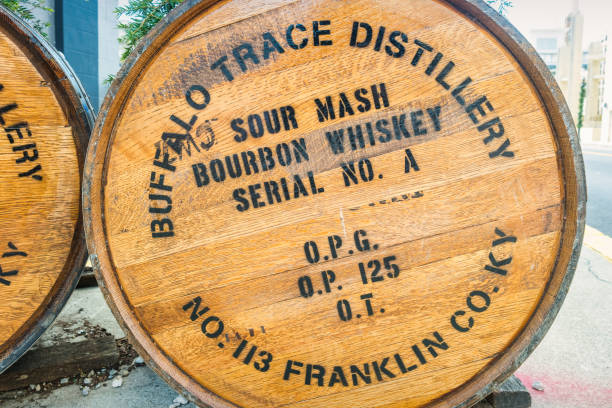
Backset links one distillation to the next
Backset is the acidic liquid left after distillation. Returning a portion to the next mash lowers pH, helps control unwanted microbes and makes fermentation conditions more consistent. The amount varies by distillery.
Yeast strain, temperature and fermentation time influence the aromas and flavours produced alongside alcohol. Many large American distilleries ferment with the grain solids still present, so the finished distiller’s beer also carries grain solids into the still.
Connected knowledgeCompare sour-mash control with Scotch washback fermentation →
Corn enters at the higher cook temperature; other grains follow as the mash cools.
Malted barley and other enzyme sources convert opened starch into fermentable sugar.
Backset lowers pH and helps establish consistent fermentation conditions.
Yeast converts sugars into alcohol and produces esters and other flavour compounds.
A sweet mash is made without recycled backset. The distiller manages acidity and microbial control in other ways. The name does not tell you how sweet the finished whiskey tastes.
Older practices could allow mash to acidify before yeast addition. Modern American usage usually refers to the deliberate reuse of backset.
Universal foundationExplore how yeast and fermentation influence flavour →
Continue · Chapter 05Distillation shapes the spirit →Distillation shapes the spirit
Bourbon may leave the still at no more than 160 proof. The distiller’s equipment and operating choices determine its character within that limit.
How do Bourbon stills work?
Many large Bourbon distilleries feed fermented mash into a continuous beer still designed to handle grain solids. A second distillation stage follows, using a doubler or thumper. Other producers use pot stills or hybrid systems; the Bourbon standard does not prescribe one still design.
The maximum of 160 proof is below the 190 proof minimum for neutral spirits. Within that limit, copper contact, reflux, collection decisions and operating conditions influence how much flavour the spirit retains.
White dog and new make are common terms for the spirit before barrel maturation.
The vapour from the first still is condensed into liquid, then redistilled in a heated vessel. A condenser collects the resulting spirit.
Vapour from the beer still passes directly into the thumper, supplying heat for the second stage without first being condensed.
125 proof is the maximum, and distillers may fill barrels at a lower strength. Changing the proportion of water and alcohol changes how the spirit extracts compounds from oak.
Universal foundationExplore still design, reflux and distillation strength →
Continue · Chapter 06Charred new oak defines the barrel →Charred new oak defines the barrel
Bourbon must be stored in charred new oak. The wood and the way it is heated have a strong influence on flavour.
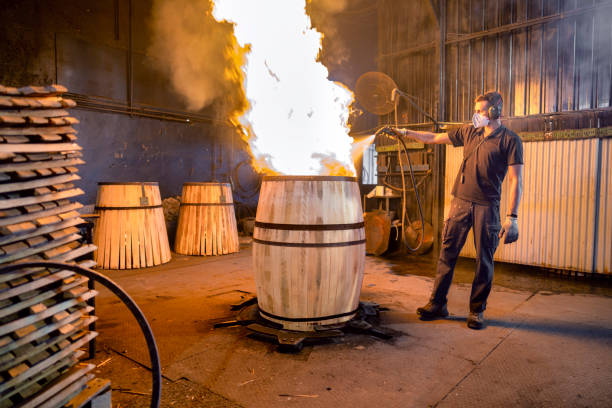
How heat changes oak
Toasting and charring transform wood before whiskey arrives. Vanillin contributes vanilla; whiskey lactones contribute woody or coconut-like aromas; eugenol and isoeugenol contribute clove-like spice; and guaiacol can contribute smoky notes.
The charred surface can adsorb some compounds. Cracks expose the heat-treated wood beneath it, where the spirit extracts colour and flavour. Oak selection, seasoning, toasting, charring and entry proof all give the distiller ways to shape maturation.
Fresh oak supplies compounds that contribute colour, aroma, flavour and tannin.
Toast and char reshape lignin, oak lipids and other wood components into new aroma precursors.
The carbonized surface adsorbs some compounds and exposes cracked, heat transformed layers below.
The balance of water and alcohol affects which compounds the spirit extracts from wood.
Char levels describe the cooper’s treatment of the barrel. Char 4 is known for its cracked “alligator” surface. Federal Bourbon rules do not specify a particular char level.
Continue the subject
Warehouse conditions change each barrel
Temperature, humidity and airflow vary within a warehouse. Barrels filled with the same spirit can mature differently depending on where they sit.
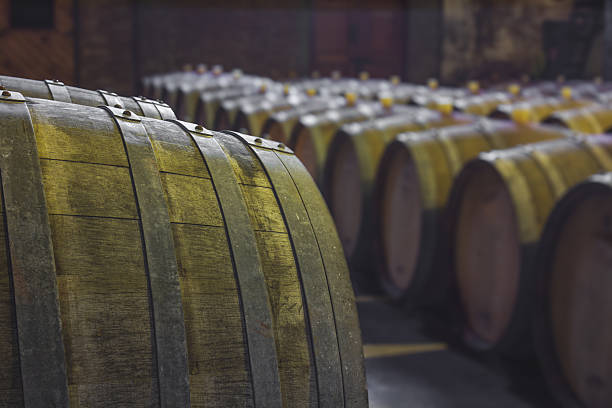
Position changes maturation
Seasonal warming and cooling change the rate of extraction and reaction inside the barrel. Warmer zones usually move faster; cooler zones move more slowly. Humidity changes the relative loss of water and ethanol, so barrel proof can rise or fall according to local conditions.
Age therefore tells you time in oak, while maturity tells you what that time actually produced. Two barrels with the same age statement can carry very different oak intensity, proof and texture.
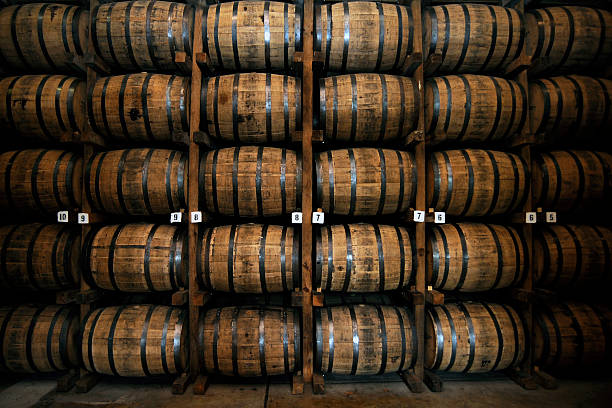
Buffalo Trace compared barrels filled with the same Bourbon recipe on the same day and aged for 12 years on Floors 1, 5 and 9 of Warehouse K. The different profiles illustrate how warehouse position can influence maturation.
Warehouse design
Different buildings create different conditions
Warehouse height, construction and barrel arrangement affect temperature and humidity. A tall American rickhouse can have marked differences between its upper and lower floors. A low warehouse generally has less vertical variation. Comparing rickhouses with the traditional dunnage warehouses used in Scotland helps explain why the building matters.
Traditional / Dunnage
Low buildings and fewer barrel levels
Traditional Scottish dunnage warehouses often have stone walls and earth or sand floors. Casks rest on wooden rails, usually two or three high. Conditions tend to be relatively stable, with less variation between upper and lower casks.
What it offers Relatively steady, often humid conditions, with limited capacity and considerable manual cask handling.
Racked / Rackhouse
More barrel levels and greater variation
Racked warehouses hold barrels on multiple levels. In tall American rickhouses, upper floors are usually warmer than lower ones. That temperature difference can produce a range of flavours and strengths within the same building.
What it offers More storage capacity and a range of barrel profiles for the producer to select or combine.
Charred new oak is required, with no federal minimum ageing period.
At least two years in charred new oak. The same restrictions on additions apply.
Whisky younger than four years must state age. For mixtures without neutral spirits, the statement follows the youngest whisky in the bottle.
How are barrels selected?
After maturation, the producer may bottle a single barrel or combine several. Tasting helps identify barrels with the desired balance of oak, fruit, spice and texture. Barrels from different floors or warehouses can complement each other.
Single barrel shows the character of one selected cask. Batching lets a producer build consistency, soften extremes or aim for a specific balance of oak, proof, texture and aromatic style.
Longer maturation can increase concentration, oak extraction and dryness, but quality still depends on what the barrel delivered and how the final release was selected.
Read the Bourbon label in order
Start with the whiskey type, state of distillation, age and strength. These tell you more than many of the descriptive phrases on the bottle.
What do proof claims mean?
Bottled in Bond, Barrel Proof, Cask Strength and Original Proof have specific federal requirements.
Barrel Proof or Cask Strength allows a bottling proof no more than two proof degrees below the proof at which the spirit was dumped from wood. Original Proof or Entry Proof means the bottling proof equals the strength at which the spirit originally entered the barrel.
When Bourbon moves from its required charred new oak into a used Sherry, wine or other finishing cask, TTB uses a qualifying specialty designation such as Bourbon Whisky Finished in Sherry Barrels.
Bottled in Bond
One distiller. One distillery. One season. Four years. 100 proof.
For Bourbon, Bottled in Bond identifies a whiskey from one distiller, one distillery and one distilling season, aged for at least four years and bottled at 50% abv. All the usual Bourbon requirements also apply.
Distilling season: 1 January to 30 June or 1 July to 31 December. U.S. labels also identify the distilling and bottling plant numbers.
Usually means the whiskey comes from one selected barrel. Check the producer’s explanation, including how strength is adjusted before bottling.
There is no federal numerical limit on the size of a “small batch.” Check whether the producer states how many barrels it uses.
These describe mash bill choices. The terms alone give no exact grain percentage; a published recipe is more informative.
Bourbon reaches beyond Kentucky
Bourbon can be made across the United States. A state name on the label provides more specific information about its origin.
State names carry legal weight
Every U.S. Bourbon label must disclose the state of original distillation somewhere. When a state becomes part of the whisky designation, such as Kentucky Bourbon Whisky, the distillation and any required aging must also occur in that state.
Kentucky has a long distilling history, established cooperages and extensive warehouses. Climate and local production choices influence its Bourbons, just as they do in other states.
Tennessee
A state defined whiskey identity
Tennessee law requires Tennessee Whiskey to be manufactured and aged in Tennessee, contain at least 51% corn, meet the 160 and 125 proof limits, use charred new oak and undergo maple charcoal filtration before aging under the state rule and its narrow statutory exception.
Limestone water is part of Kentucky’s distilling tradition. Bourbon law does not require it or prescribe a particular water source.
Taste and serve with understanding
Describe what you smell and taste, then use production details to help explain it.
Describe first. Explain second.
Across Bourbon and other charred new oak American whiskies, vanilla is one of the clearest oak linked cues. Vanillin is strongly aroma active; whiskey lactones can read woody or coconut like; eugenol can read clove like; and char related phenols can move toward smoke or toast. Fruit, cereal and fermentation derived notes may sit underneath or alongside them.
Oak notes vary in intensity, and fruit or grain aromas may be just as noticeable. Corn Whisky and American Single Malt can use different barrel types, so their flavours may differ considerably from Bourbon.
Connected knowledgeUnderstand how water can change aroma release, alcohol intensity and texture →
A practical tasting sequence
Work through aroma, flavour, texture and finish. This makes it easier to compare bottles and notice what changes when you add water.
Choose how to serve it
Consider the bottle’s strength and flavour alongside the guest’s preferences. Neat, with water or in a cocktail can each be a good choice.
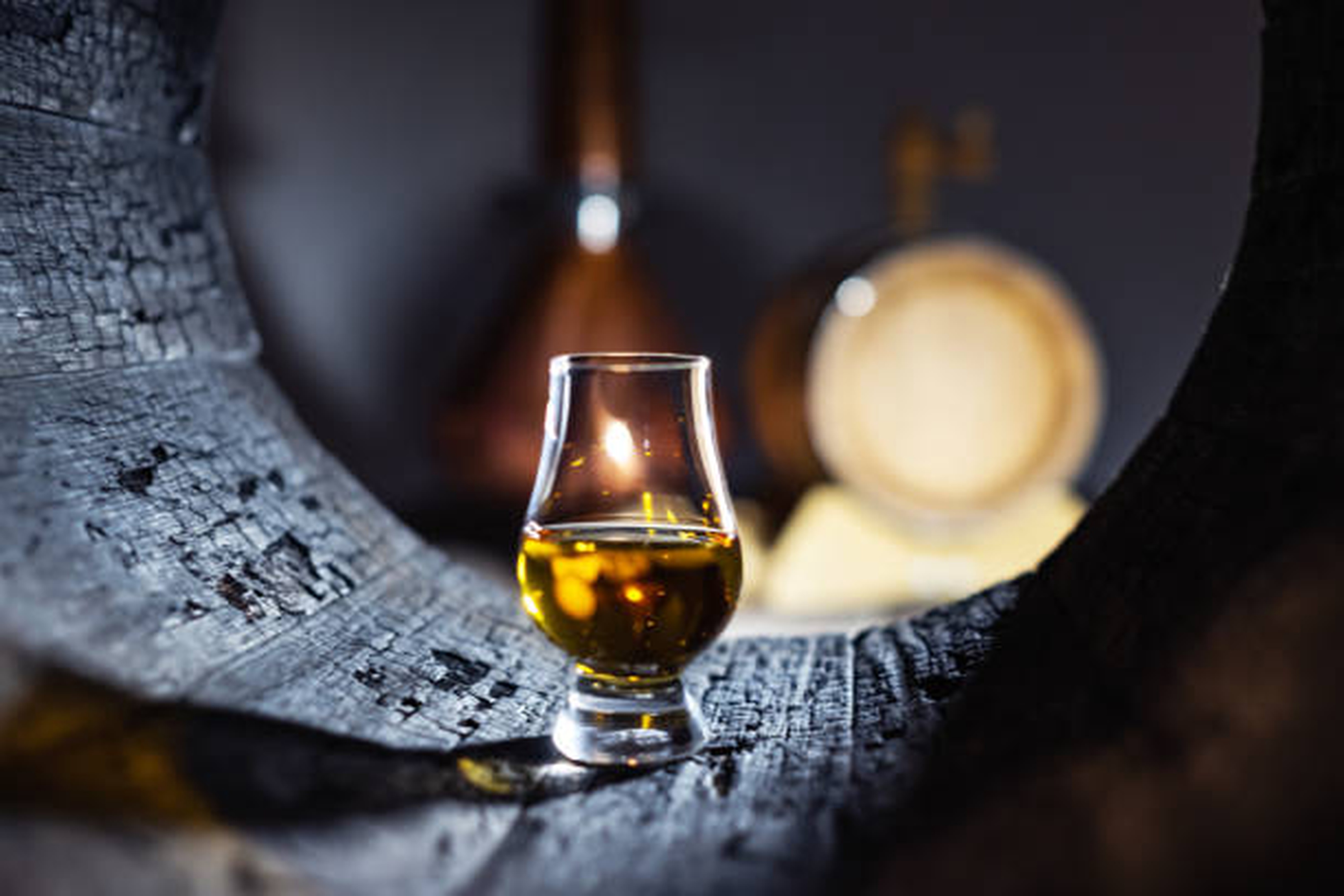
Use a tulip shaped glass for training or detailed comparison. Give high proof whiskey time in the glass before changing it.
Add a few drops, taste again and adjust. The useful amount depends on the whiskey’s strength and your preference.
Bourbon works naturally in an Old Fashioned, Whiskey Sour, Mint Julep and Boulevardier. Rye often brings a firmer spice profile to the same family of drinks.
Try smoked meat, roasted nuts, aged cheese or dark chocolate. Match the food’s intensity to the whiskey and see which flavours complement each other.
Protect the bottle
Bottle storage preserves the spirit after barrel maturation has ended.
Keep bottles upright and away from strong heat and direct light. Stable storage protects aroma, closure and fill condition.
A nearly empty bottle has more air above the liquid, which can affect aroma over time. Keep it well sealed and avoid leaving small amounts for long periods.
Core principle
Law sets identity.
Producer choices create style.
The law establishes Bourbon’s origin, grain content, proof limits and barrels. The distiller’s choices explain its individual flavour: mash bill, yeast, stills, entry proof, oak, warehouse position and the barrels selected for bottling.
REFSources & Further Reading
Primary legal and technical references behind this Bourbon & American Whiskey guide. Federal category and label provisions were checked on 24 September 2026.
Federal law & labels
27 CFR § 5.143 · WhiskyFederal standards of identity · Bourbon, Rye, Corn, Straight, Blended and American Single Malt 27 CFR § 5.74 · Age statementsFederal age, storage and youngest whisky rules 27 CFR § 5.87 · Barrel ProofFederal meaning of barrel proof, cask strength and entry proof 27 CFR § 5.88 · Bottled in BondSame distiller, distillery, season; 4+ years; 100 proof TTB · Distilled Spirits FAQsOfficial guidance · whisky age statements TTB · Formulas and LabelsOfficial examples · plain Bourbon vs finished specialty productsAmerican category law
TTB · American Single Malt WhiskyFinal standard effective 19 January 2025 Tennessee General Assembly · HB1084State Tennessee Whiskey requirements and maple charcoal rule 27 CFR § 5.66 · State of distillationMandatory state of distillation disclosure and geographic designation rules for U.S. whisky 27 CFR § 5.1 · DefinitionsFederal meaning of age for Bourbon and other whiskiesProduction & oak
Buffalo Trace · Distillery ProcessProducer example · grain, fermentation, distillation and charred new oak Maker’s Mark · Bourbon Making ProcessProducer example · wheated mash, limestone water, sour mash and the brand’s use of “Whisky” on its Kentucky Straight Bourbon label Four Roses · Our ProcessProducer example · two mash bills, five yeast strains and ten Bourbon recipes Ross & Squibb · Lawrenceburg, IndianaProducer example · Straight Bourbon and Rye made outside Kentucky Buffalo Trace · Experimental CollectionProducer experiments · mash bill, wood, char, entry proof and maturation variables Buffalo Trace · Warehouse Floors ExperimentSame recipe and fill date · 12 years on Floors 1, 5 and 9 of Warehouse KEdinburgh Whisky Academy · Warehousing SystemsTraditional dunnage, racked and palletised storage · construction, capacity, temperature and humidity UC Davis · Oak LactonesWood chemistry · oak derived aroma compoundsSensory & service
Oak Aged Spirits · Aroma Active CompoundsPeer reviewed research · Bourbon vanillin, whiskey lactones, spice, smoke and oak derived aroma compounds Impact of Dilution on Whisky AromaPeer reviewed research · Bourbon/rye/Scotch aroma changes with progressive water dilution IBA · Old FashionedOfficial cocktail reference IBA · Whiskey SourOfficial cocktail referenceThe takeaway
Know the requirements.
Understand the choices.
Corn, proof limits and charred new oak define Bourbon. The grain recipe, yeast, distillation, warehouse and barrel selection help explain why one bottle tastes different from another.